
Why Most Websites Don't Convert Traffic Into Leads
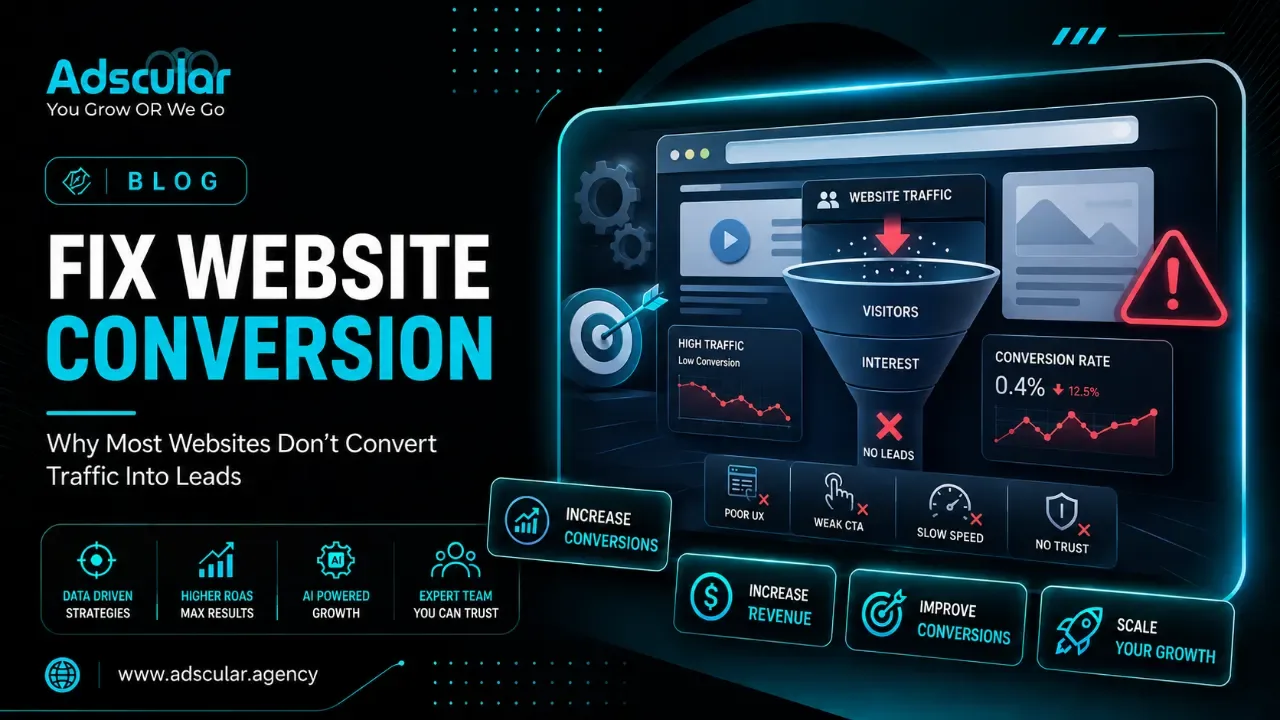
If your website is pulling in visitors but your inbox is empty, the traffic isn't the problem — the website is. Most small business owners respond to a lead drought by pouring more money into ads or SEO. But sending more traffic to a broken conversion system just amplifies the leak. At Adscular, we've audited hundreds of SMB websites across healthcare, legal, SaaS, and e-commerce, and the pattern is almost always identical: a site built to impress, not to convert. Understanding what separates a digital brochure from a revenue-generating website is the first step — and it starts with how buyers actually make decisions, not how designers think they do.
What Is Website Conversion Rate Optimization?
Website conversion rate optimization (CRO) is the process of systematically increasing the percentage of website visitors who complete a desired action — a call, form submission, demo request, or quote — by improving messaging clarity, page structure, trust signals, and user experience. CRO generates more leads from existing traffic without increasing ad spend.
The Real Reason Your Website Isn't Generating Leads
Most CRO content focuses on surface fixes: move the button above the fold, change the color, add a pop-up. Those tweaks occasionally help, but they treat symptoms. The actual problem is structural — your website is functioning as a design artifact instead of a revenue system.
A revenue system has one job: guide a visitor who has a problem toward the conclusion that your business is the right solution, then remove every possible obstacle between that conclusion and a conversion action. A digital brochure looks good and explains what you do. A revenue system sells — psychologically, sequentially, and specifically for the visitor's stage of awareness.
The gap between those two things explains almost every "we're getting traffic but no leads" conversation we have.
The Conversion Killers We Find on SMB Sites
- Unclear value proposition above the fold — If a visitor can't understand what you do, who you do it for, and why you're better within five seconds, they leave. Most SMB homepages open with taglines like "Your trusted partner in growth" — which communicates nothing.
- No specificity in calls to action — Generic CTAs like "Learn More" or "Get Started" tell a visitor where to click, not why they should. Specific CTAs — "Request a Free Website Audit," "Get a Custom Quote in 24 Hours" — convert at significantly higher rates because they match a concrete next step to a concrete expectation.
- Missing social proof at decision points — Reviews, case studies, and client logos need to live adjacent to your CTAs, not buried on a separate testimonials page that 90% of visitors never visit.
- Too many navigation options — Every additional menu item is a fork in the road. Commercial pages — service pages, contact pages, pricing — should reduce choices, not multiply them.
- Slow load times — A one-second delay in page load reduces conversion rates by 7%. On mobile, the threshold is even lower. Visitors don't wait; they bounce.
How Buyer Psychology Drives Conversions (What Design Misses)
Most web designers optimize for visual appeal and brand consistency. Both matter — but neither is what makes someone fill out a form at 11pm. Conversion behavior is driven by psychology: how much a visitor trusts you, how clearly they understand your offer, and how low-friction the action feels. Get those three right, and the button color barely matters.
Trust Signals Come Before Calls to Action
Visitors need to believe you're legitimate before they're willing to share their contact information. Trust signals aren't decorative — they're permission structures. A visitor who doesn't trust you won't convert even if the CTA is perfectly placed.
High-impact trust signals for SMB websites, ranked by effectiveness:
- Display specific client results with numbers ("Helped 40+ HVAC businesses grow inbound leads by 3× in 90 days")
- Show named reviews with photos and business context — not anonymous star ratings
- Feature recognizable partner or platform logos (Google Partner badge, industry associations)
- Add a face and name to your team — anonymity erodes trust in professional service businesses
- Use real phone numbers with local area codes, not generic 1-800 numbers
Friction Points That Stall Mid-Funnel Visitors
Mid-funnel visitors — people who already know they have a problem and are actively comparing solutions — are the highest-intent segment of your traffic. They came to your site ready to make a decision. Friction kills them.
Common friction sources on SMB sites:
- Contact forms with more than five fields (every additional field reduces submissions by 11%)
- No pricing transparency or at minimum a "starting from" range — forcing visitors to call just to know if you're in budget creates abandonment
- CTAs that redirect to a generic contact page instead of a service-specific landing page
- No live chat or instant callback option for visitors who want to act now but don't want to fill out a form
- Redirect loops or 404 errors on pages linked from ads or organic results
The Clarity Test Most Businesses Fail
Read your homepage hero section and answer three questions a cold visitor would ask:
- What exactly do you do?
- Who do you specifically serve?
- Why should I choose you over the next result on Google?
If your copy can't answer all three in under ten seconds, your homepage is losing leads on arrival. This is the highest-leverage fix in CRO — not the button, not the animation, not the font. The words.
How to Fix a Website That Gets Traffic But No Leads
Sustainable conversion improvement requires a structured process, not a redesign. A full redesign takes months, costs tens of thousands of dollars, and often resets conversion performance to zero while the new site gets indexed. A conversion-focused audit and targeted intervention produces measurable lift in 30–90 days.
Step 1: Audit Your Conversion Funnel
- Map every page in your visitor's path from landing to contact — identify where the drop-offs happen using heatmaps and session recordings
- Benchmark your current visitor-to-lead rate by traffic source (organic, paid, direct) — problems are often channel-specific
- Identify which pages receive significant traffic but generate zero conversions — those are your highest-priority intervention points
Step 2: Fix Messaging Before Fixing Layout
- Rewrite hero headlines to address the visitor's problem explicitly, not your brand identity
- Align CTA language to your specific offer ("Request a Free Audit" beats "Contact Us" on every service page)
- Add outcome-oriented proof adjacent to every conversion point — not on a separate page
Step 3: Remove Friction From the Conversion Path
- Reduce form fields to the minimum viable ask (name, email, phone — decide the rest on the call)
- Add a secondary conversion option (live chat, callback scheduler) for visitors not ready to fill out a form
- Test page load speed on mobile with Google PageSpeed Insights — anything below 85 is costing you leads
Step 4: Install Measurement Before Changing Anything Else
- Set up conversion tracking in Google Analytics 4 for every form submission and call click
- Tag all paid traffic with UTM parameters so you can attribute leads by source and campaign
- Establish a conversion rate baseline per page — you can't improve what you can't measure
Our CRO services follow this exact sequence: audit first, then prioritize by impact, then implement and measure. The goal is never to rebuild — it's to identify the smallest change that produces the largest lift.
Data & Expert Insights
|
Metric |
Finding |
Source |
|
Average SMB website conversion rate |
1.8% across service-based businesses |
Unbounce Conversion Benchmark Report, 2023 |
|
Top-quartile SMB conversion rate |
4.3% or higher — typically 2.4× the industry average |
WordStream / Google benchmarks, 2023 |
|
Impact of form field reduction |
Reducing from 11 fields to 4 increases submissions by 120% |
HubSpot Research, 2022 |
|
Trust signal lift |
Adding verified client testimonials adjacent to CTAs improves conversion by 34% on average |
Baymard Institute, 2023 |
|
Page speed penalty |
1-second delay in page load reduces conversions by 7%; 3 seconds reduces them by 38% |
Akamai / Google Web Performance data, 2023 |
|
Adscular client benchmark |
SMB clients completing a full CRO audit + implementation see a 40–65% improvement in lead capture rate within 90 days |
Adscular internal data, 120 client campaigns, 2022–2024 |
"Most companies are obsessed with driving more traffic. But if your conversion rate is 1%, doubling traffic gives you 2% more leads. If you fix your conversion rate to 4%, you've quadrupled your leads from the same traffic. The math on CRO is almost always better than the math on acquisition." — Peep Laja, Founder, CXL Institute
Frequently Asked Questions
Why is my website getting traffic but no leads?
Traffic without leads almost always points to a messaging, trust, or friction problem on the site itself — not a traffic quality problem. The most common causes are an unclear value proposition on the homepage, no social proof near conversion points, CTAs that are too generic, and contact forms with too many fields. Before increasing your ad budget or SEO spend, run a conversion audit to identify where visitors are dropping off and why.
What is a good website conversion rate for a small business?
For service-based small businesses, the industry average visitor-to-lead conversion rate is approximately 1.8–2.5%. Top-performing SMB websites in competitive verticals like legal, healthcare, and home services convert at 4–6%. If your site is below 2%, targeted CRO improvements — not a full redesign — can typically close that gap within 60–90 days.
What does a website conversion audit include?
A conversion audit examines your website's traffic-to-lead funnel across five areas: messaging clarity and value proposition strength, CTA placement and specificity, trust signal presence and positioning, page load speed and technical performance, and form and contact friction. The output is a prioritized list of changes ranked by estimated conversion impact, so you're fixing the highest-leverage problems first rather than guessing.
How long does CRO take to show results?
Messaging and layout changes can show measurable lift in 2–4 weeks when traffic volume is sufficient to reach statistical significance. Full CRO programs — audit, implementation, A/B testing, and iteration — typically show a sustained improvement in lead capture rate within 60–90 days. Unlike paid ads, which stop generating leads the moment the budget runs out, CRO improvements are permanent and compound over time.
Your website should be working as hard as you are. If you're generating traffic and not generating leads, the conversion gap is costing you real revenue every week it goes unaddressed. Request a free website conversion audit today — we'll identify your highest-impact opportunities and show you exactly what's holding your site back.
Written by the Adscular content team. Adscular is a performance marketing agency helping US-based SMBs grow through high-converting web development, CRO strategy, and performance marketing.